The Sacred Web of Life: Honoring Our Connection to All Beings
Crafted by Lee Black: Weaving Wisdom for Your Journey
Imagine a spider’s web glistening in the morning dew, each strand delicately connected to the next, forming a structure that is both fragile and resilient. This image is a perfect metaphor for the Web of Life—a concept deeply rooted in Indigenous wisdom and echoed in Jungian psychology. The Web of Life teaches us that all living beings, from the smallest insect to the tallest tree, are interconnected, forming a sacred tapestry that binds us to one another and to the Earth.
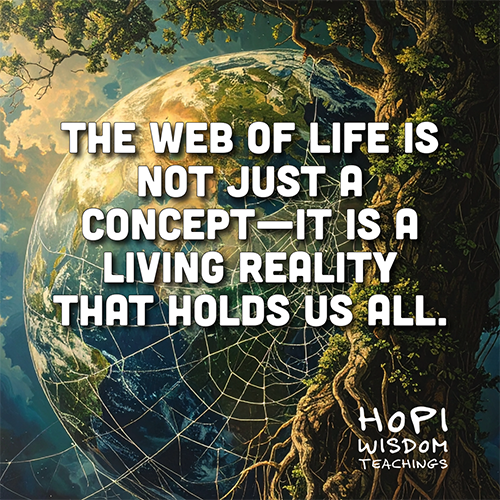
The Web of Life is not just a poetic idea—it is a living reality. Indigenous teachings emphasize that all things are connected, not only in the physical world but also in the spiritual realm. In other words, this interconnectedness encompasses the energy of ancestors, the spirits of animals, and the vibrations of the Earth itself.
At its core, the Web of Life reminds us that we are but strands in this intricate network, not the web itself. Each strand is vital, and every action we take affects the entire structure. Therefore, if one strand is broken, the web sags, losing its strength and balance. This understanding calls us to recognize our responsibility within the web and to act in ways that honor and sustain its integrity.
Nature offers us countless examples of the Web of Life in action. For instance, consider the forest, where the roots of trees intertwine beneath the soil, sharing nutrients and water. This underground network, often referred to as the “wood wide web,” is a living testament to the interconnectedness of all life. In addition, trees communicate, support one another, and even warn each other of danger, ensuring the survival of the entire ecosystem.
Similarly, the cycles of nature—birth, growth, death, and renewal—mirror the cycles of our own lives. Just as the seasons flow seamlessly from one to the next, we too experience times of growth, harvest, rest, and rebirth. Nature teaches us that balance is not static; rather, it is a dynamic process of constant adjustment and adaptation.
The Web of Life reminds us that every action we take sends ripples through the web, touching lives and ecosystems in ways we may never fully understand. For example, a single act of kindness, a moment of gratitude, or a decision to live more sustainably can create waves of positive change.
Take recycling, for instance. When we choose to recycle, we contribute to the health of the planet. Likewise, when we smile at a stranger, we brighten their day, and they may pass that kindness on to someone else. These small actions may seem insignificant, but they have the power to create a ripple effect that strengthens the web.
Reciprocity is a cornerstone of the Web of Life. In essence, it is the practice of giving back in equal measure to what we receive, ensuring balance and harmony. Indigenous teachings emphasize the importance of reciprocity in all aspects of life, from our relationships with others to our interactions with nature.
For instance, when we take from the Earth, we must give something back. This could be as simple as planting a tree, offering a prayer of gratitude, or leaving a small gift in return. Ultimately, reciprocity reminds us that we are not separate from the web—we are active participants in its flow.
To honor the Web of Life, we must walk in Right Relationship with ourselves, others, and the Earth. In other words, Right Relationship is about living in a way that respects and nurtures the interconnectedness of all life. It requires us to be mindful of our actions, to practice kindness and compassion, and to seek balance in all things.
Furthermore, living in Right Relationship is not just a personal practice—it is a collective responsibility. When we live in harmony with the web, we contribute to the creation of a new world—a Fifth World—where balance, beauty, and connection are the guiding principles.
The Web of Life is not just a concept—it is a living reality that holds us all. When we trust the web, we find peace in knowing that we are part of something greater. We learn to surrender to its wisdom, to let go of our need for control, and to embrace the mystery of life.
As Chief Seattle said, “We do not weave the web of life; we are merely a strand in it. Whatever we do to the web, we do to ourselves.”
So, let us honor the web by living in Right Relationship, practicing reciprocity, and dreaming forward a world of balance and harmony. Let us remember that every action we take matters, and every ripple we create has the power to transform the world.
May we walk in beauty, trust the web, and weave a tapestry of connection and harmony for generations to come.
Next Steps in Your Journey:
How do you honor your connection to the Web of Life? Share your story with us and inspire others to live in harmony with all beings!
Blessings in you walk, Lee
This post is part of our Ripples of Wisdom series, where we explore the timeless teachings of Ancestral wisdom and share insights to help you live in balance with yourself, others, and Mother Earth. Together, we’ll uncover how small, intentional actions can create ripples of transformation in our lives and the world around us.